Return to course: OIIQ Question Bank
RN101 Question Bank
Previous Lesson
Previous
Next
Next Lesson
Atrial Fibrillation (23 Questions)
1. Mr. Jean-Paul Gagnon, a 74-year-old man, is recovering on the surgical unit after undergoing thoracic lobectomy for early-stage lung cancer three days ago. His past medical history includes hypertension, type 2 diabetes, and paroxysmal atrial fibrillation. His anticoagulant therapy (apixaban) was held prior to surgery and has not yet been resumed.
So far, his recovery has been uneventful—he's been alert, oriented, and mobile with assistance.
At 14:15, you are urgently called to his room. You find Mr. Gagnon confused, with right-sided facial drooping, slurred speech, and right arm weakness. His blood pressure is 164/92 mmHg and his heart rate is irregular at 102 bpm.
Question:
What do you suspect is happening to the patient?
*
Pulmonary embolism
Acute ischemic stroke
Postoperative delirium
Transient hypoglycemia
2.1 Mr. Laurent Boucher, a 78-year-old patient with a history of chronic heart failure and atrial fibrillation, is under your care in the medicine unit. His usual medications include:
*Bisoprolol (Monocor®) 5 mg PO once daily
*Diltiazem (Cardizem®) 120 mg PO twice daily
At 08:00, you prepare his morning medications and assess his vital signs:
*Blood Pressure: 98/60 mmHg (previously 108/64 mmHg)
*Heart Rate: 58 bpm (previously 68 bpm), regular
*Respiratory Rate: 18 breaths/min
*O2 Saturation: 96% on room air
He is awake and alert, reports no dizziness, chest pain, or shortness of breath.
Question:
Will you administer Monocor (Bisoprolol) and Cardizem (Diltiazem)?
*
Yes, give both medications as prescribed.
Hold both medications and notify the physician.
Administer Monocor only.
Hold Monocor and reassess in one hour.
2.2 Following the earlier episode of pulmonary edema, Mr. Laurent Boucher remains under observation. His physician has prescribed Furosemide (Lasix®) 40 mg IV STAT to manage his fluid overload and relieve respiratory symptoms. You are preparing to administer the medication.
Question:
What should you evaluate first?
*
Blood glucose level
Presence of bowel sounds
Assess lung sounds
Pupil size and reaction
2.3 Mr. Laurent Boucher, who was admitted for worsening heart failure and pulmonary edema, is currently under a fluid restriction of 1.5 liters per day.
His daughter expresses concern and asks how she can help support her father during his hospitalization and at home.
Question:
What is the most appropriate advice to give to Mr. Boucher’’s daughter to help monitor his fluid restriction?
*
Write down everything he eats as food.
Weigh him daily at the same time.
Observe the color and odor of his urine.
Monitor his oxygen saturation after each meal.
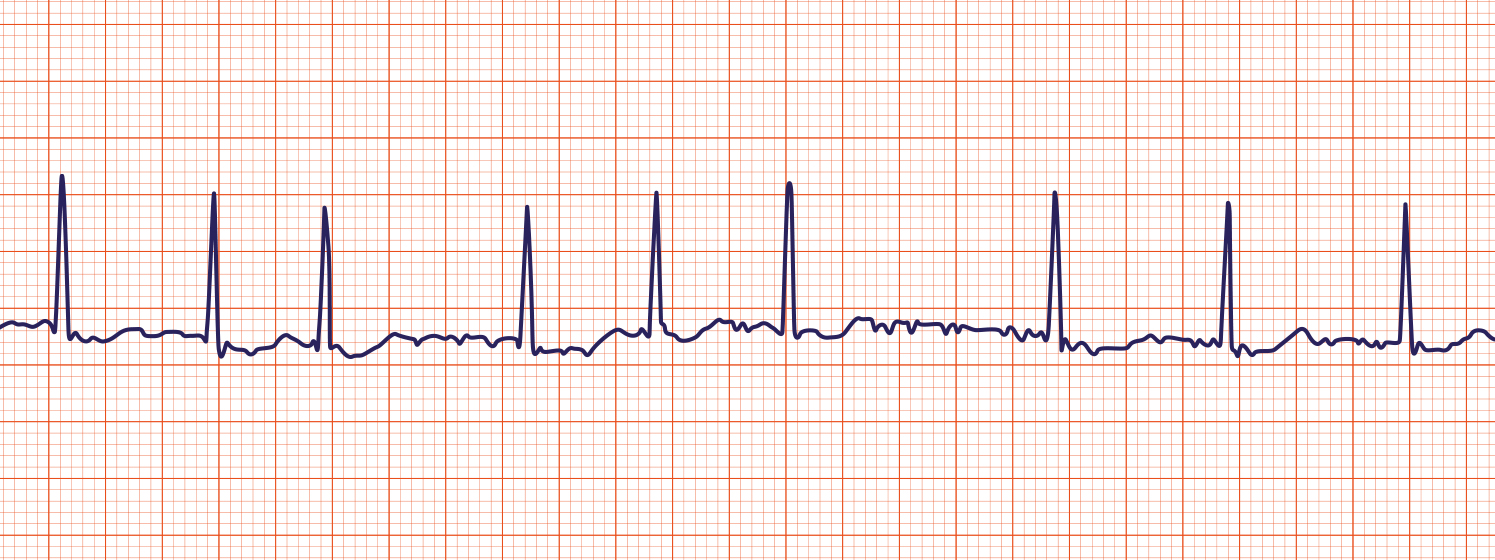
3.1 Mr. Michel Beaudry, 79 years old, is admitted to the telemetry unit for monitoring after complaining of palpitations and lightheadedness. He has a history of hypertension and coronary artery disease. You are reviewing his cardiac monitor during your shift.
Suddenly, his cardiac rhythm changes.
The monitor now shows the following: (See image below)
Question:
What do you suspect is happening to the patient?
*
Sinus tachycardia
Atrial fibrillation
Ventricular fibrillation
Ventricular tachycardia
3.2 Following the episode of atrial fibrillation, the physician reviews Mr. Beaudry’s condition and prescribes metoprolol (Lopressor) to help control his heart rate.
The order reads:
*Metoprolol 25 mg PO bid.
You are now preparing to administer the first dose.
Question:
Which monitoring is essential when administering this medication?
*
ST segment
Heart rate
Troponin
Myoglobin
3.3
Question:
In addition to metoprolol, what medication does the nurse expect to administer?
*
Heparin
Atropine
Dobutamine
Magnesium sulfate
3.4 Later in the shift, you come in to administer warfarin (Coumadin) to Mr. Michel Beaudry. He looks confused and says,
"I’m already on blood thinner. Why are you giving me this pill now too? I'm worried I might bleed."
Question:
What is your best response to Mr. Beaudry?
*
“You're right to be concerned, let me call the doctor to stop the medication.”
“Warfarin and heparin work differently but have the same effect, so we always give both.”
“This pill is just a backup in case the heparin doesn’t work.”
“It takes 3–5 days for warfarin to reach its full effect, so we give both until it becomes therapeutic.”
3.5 As part of his discharge teaching, you begin reviewing important information about dietary considerations while taking warfarin.
When you explain that vitamin K can affect how warfarin works, Mr. Beaudry becomes concerned and says:
"Oh no, I eat a lot of broccoli. I love it—should I stop eating it now that I’m on this medication?"
Question:
What is the best response to give Mr. Beaudry?
*
“Yes, you’ll need to stop eating broccoli completely.”
“Eat as much broccoli as you want—it doesn’t really affect your medication.”
“You don’t need to stop eating broccoli, but it’s important to keep your intake consistent.”
“Just eat broccoli only on the days you don’t take your medication.”
3.6 Mr. Michel Beaudry asks you another question:
"I usually have grapefruit or grapefruit juice with breakfast—should I still drink that now that I’m taking warfarin?"
Question:
What is the best response to give Mr. Beaudry?
*
“It’s fine as long as you drink it in the evening, not in the morning.”
“It’s best to avoid grapefruit products while on warfarin.”
“Grapefruit is high in vitamin K, so you just need to eat less of it.”
“You can continue as long as your INR is normal.”
3.7 Mr. Michel Beaudry expresses concern about bleeding risk now that he’s taking warfarin. He says:
"I’m worried I might bleed easily. Are there things I should change in my daily routine—like when I shave or brush my teeth?"
Question:
What is the most appropriate recommendation to reduce bleeding risk during hygiene care?
*
“Use a soft-bristled toothbrush and an electric razor.”
“Use regular floss and a straight razor, just be gentle.”
“Switch to mouthwash only and avoid shaving completely.”
“No changes needed, just continue your usual routine carefully.”
3.8 While reviewing his home medications, he says:
“At home, I sometimes take Aspirin 325 mg when I have a headache or some joint pain. I also use St. John's Wort for stress. Can I continue those?”
Question:
What is your best response?
*
“Yes, both are safe with warfarin since they are over-the-counter.”
“Stop St. John's Wort but continue taking aspirin to manage pain.”
“Avoid both aspirin and St. John's Wort unless approved by your doctor.”
“You can continue taking both if you take warfarin at a different time of day.”
3.9 Before Mr. Michel Beaudry leaves the unit, you review the final discharge instructions with him. He nods as you go over his warfarin dose and dietary advice, but then asks:
“How will I know if something’s wrong with this medication? What should I be watching for at home?”
Question:
Which signs or symptoms should Mr. Beaudry report immediately?
*
Mild bruising on arms and legs
A missed dose of warfarin
Bleeding gums after brushing teeth
Brown urine or black, tarry stools
4. Mr. François Leblanc, 72 years old, is admitted to the medical unit for community-acquired pneumonia. His past medical history includes hypertension and type 2 diabetes. His current medical orders include:
*Ceftriaxone 1 g IV q24h
*Azithromycin 500 mg PO daily
*Metoprolol tartrate 25 mg PO BID
*Vital signs q4h
During the evening assessment, the nurse notes an irregularly irregular heart rhythm with a heart rate of 138 bpm. Mr. Leblanc reports palpitations and mild shortness of breath but denies chest pain. Blood pressure is 118/72 mmHg, oxygen saturation 95% on room air.
Question:
What is the nurse’s priority action?
*
Obtain a 12-lead ECG
Encourage oral fluid intake
Administer the next scheduled dose of metoprolol
Place the patient in Trendelenburg position
5. Mme. Chantal Giguère, 68 years old, has known atrial fibrillation. She presents to the emergency department with fatigue and dizziness. Current orders include:
*Cardiac monitoring
*Diltiazem IV bolus followed by infusion
*IV access x2
Her heart rate remains 150–160 bpm, blood pressure 104/66 mmHg, and she is alert but uncomfortable.
Question:
What is the primary goal of administering diltiazem in this situation?
*
Restore normal sinus rhythm immediately
Prevent clot formation
Control ventricular rate
Increase blood pressure
6. Mr. Denis Morneau, 75 years old, has chronic atrial fibrillation. He is prescribed:
*Apixaban 5 mg PO BID
*Bisoprolol 5 mg PO daily
During discharge teaching, he asks, “Why do I need a blood thinner if my heart rate is controlled?”
Question:
What is the nurse’s best explanation?
*
It lowers heart rate
It prevents myocardial infarction
It reduces the risk of stroke
It improves cardiac output
7. Mme. Louise Pelletier, 79 years old, with atrial fibrillation on Warfarin 5 mg PO daily suddenly develops right-sided weakness and slurred speech.
Question:
What is the nurse’s priority action?
*
Check INR
Reposition the patient
Activate emergency response protocol
Administer oxygen PRN
8. Mr. Jean-Paul Côté, 73 years old, with AF is on Warfarin 4 mg PO daily. His INR today is 4.2 ( 2.0 to 3.0).
Question:
What is the most appropriate nursing action?
*
Administer the medication as ordered
Repeat INR in one week
Encourage vitamin K intake immediately
Hold warfarin and notify the physician
9. Mme. Isabelle Roy, 65 years old, with atrial fibrillation for less than 24 hours, is scheduled for electrical cardioversion. Orders include:
*NPO
*Midazolam IV pre-procedure
*Continuous ECG monitoring
Question:
What is the most important nursing preparation?
*
Check blood glucose
Encourage ambulation before procedure
Administer anticoagulant immediately before cardioversion
Ensure informed consent is obtained
10. Mr. Robert Leduc, 78 years old, with AF and CHF is prescribed Digoxin 0.125 mg PO daily. He reports nausea and visual halos.
Question:
What is the nurse’s priority action?
*
Give the next dose with food
Hold digoxin
Encourage fluids
Reassure the patient
11. Mme. Sylvie Paquette, 70 years old, is postoperative day 2 following abdominal surgery. She develops atrial fibrillation with a heart rate of 140 bpm.
Question:
What factor most likely contributed to the development of AF?
*
Pain medication
Early ambulation
Use of oxygen
Hypovolemia and stress response
12. Mr. André Savard, 69 years old, has chronic AF with controlled rate on Metoprolol 50 mg PO BID and Rivaroxaban 20 mg PO daily. He is asymptomatic.
Question:
What is the nurse’s priority focus?
*
Converting rhythm to sinus
Monitoring for bleeding
Increasing heart rate
Discontinuing anticoagulation
13. Mme. Hélène Dubois, 74 years old, with AF is discharged home. She receives education on warning signs.
Question:
Which symptom requires immediate medical attention?
*
Sudden shortness of breath and chest pain
Controlled heart rate
Mild fatigue
Occasional palpitations